The Waves of Grief: Why It Hits You When You Least Expect It

Grief doesn’t follow a predictable path – it comes in waves, often triggered by unexpected moments like a song, a scent, or an anniversary. These emotional surges are natural and reflect the deep bond shared with a lost loved one, not a step backward in healing. Grief impacts your mind, body, and daily life, with effects ranging from emotional overwhelm to physical exhaustion.
Understanding why grief resurfaces can help you manage it better. Your brain alternates between processing loss and rebuilding routines, allowing space to heal. Triggers such as sensory cues or life milestones often bring back memories, while cultural pressures to "move on" can complicate the process. Grief is an ongoing journey, not something to "get over."
To navigate these waves:
- Acknowledge and name your emotions.
- Use calming techniques like mindful breathing.
- Express emotions through art, writing, or memory-focused rituals.
- Seek support from friends, groups, or professionals when needed.
Memorial art, such as custom paintings, provides a meaningful way to honor loved ones and channel grief into something tangible. These tributes can serve as anchors during tough times, helping you stay connected to cherished memories while moving forward in your healing journey.
Why Grief Comes in Waves
Common Triggers That Bring Back Grief
Grief doesn’t follow a schedule or ask for permission. Certain moments – like birthdays, anniversaries, holidays, or other significant dates – often stir up emotions tied to loss. But it’s not just the obvious events. Small, unexpected sensory cues can bring back memories in an instant. The smell of a familiar perfume, a song you both loved, or even something as random as the honk of a goose can transport you back to moments shared with a loved one. Visiting a meaningful place or hearing a phrase they used to say can have a similar effect. Even major life milestones, like the birth of a child or reaching an age your loved one never did, can bring grief rushing back, even years after the loss. These triggers play a key role in how your brain processes and manages these emotional waves.
How Your Brain Processes Grief and Memory
To protect itself from being overwhelmed, your brain sometimes dampens certain signals. This is often referred to as "grief brain" and can make everyday tasks – like remembering where you put your keys or staying focused – feel unusually difficult.
Your brain also naturally creates breaks between intense emotions, allowing you to process grief in waves. According to the Dual Process Model, the mind alternates between two states: confronting the pain of loss and adjusting to new roles and experiences.
"Healthy people oscillate between focusing on loss‑related stressors (e.g., the pain of living without the person) and restoration‑related stressors (e.g., engaging in new roles and identities due to the loss), and at other times are simply engaged in everyday life experience."
– Mary‑Frances O’Connor
This back-and-forth helps you navigate grief while continuing to live your life.
How Personal and Cultural Factors Shape Grief
While your mind handles grief internally, external factors also influence how and when grief waves hit. Your personality, the nature of your relationship with the person you lost, and the circumstances surrounding their death all play a role. For example, the grieving process may look very different for someone who loses a partner after a long illness compared to someone whose partner dies unexpectedly. On top of that, life changes – like moving, returning to work, or taking on new responsibilities – can extend and complicate the grieving process.
In the United States, grief is often treated as something to "get over" quickly, which can create unrealistic expectations and pressure to suppress emotions. This cultural attitude can backfire, causing grief to resurface more strongly later on. But those waves of grief are a testament to the deep connection you shared with the person you’ve lost.
"In our American culture, grief is underserved and undervalued… Grief is often viewed as a temporary inconvenience – much like the common cold."
– Mark Brewer
Grief Comes in Waves
How Grief Waves Affect Your Mind and Body
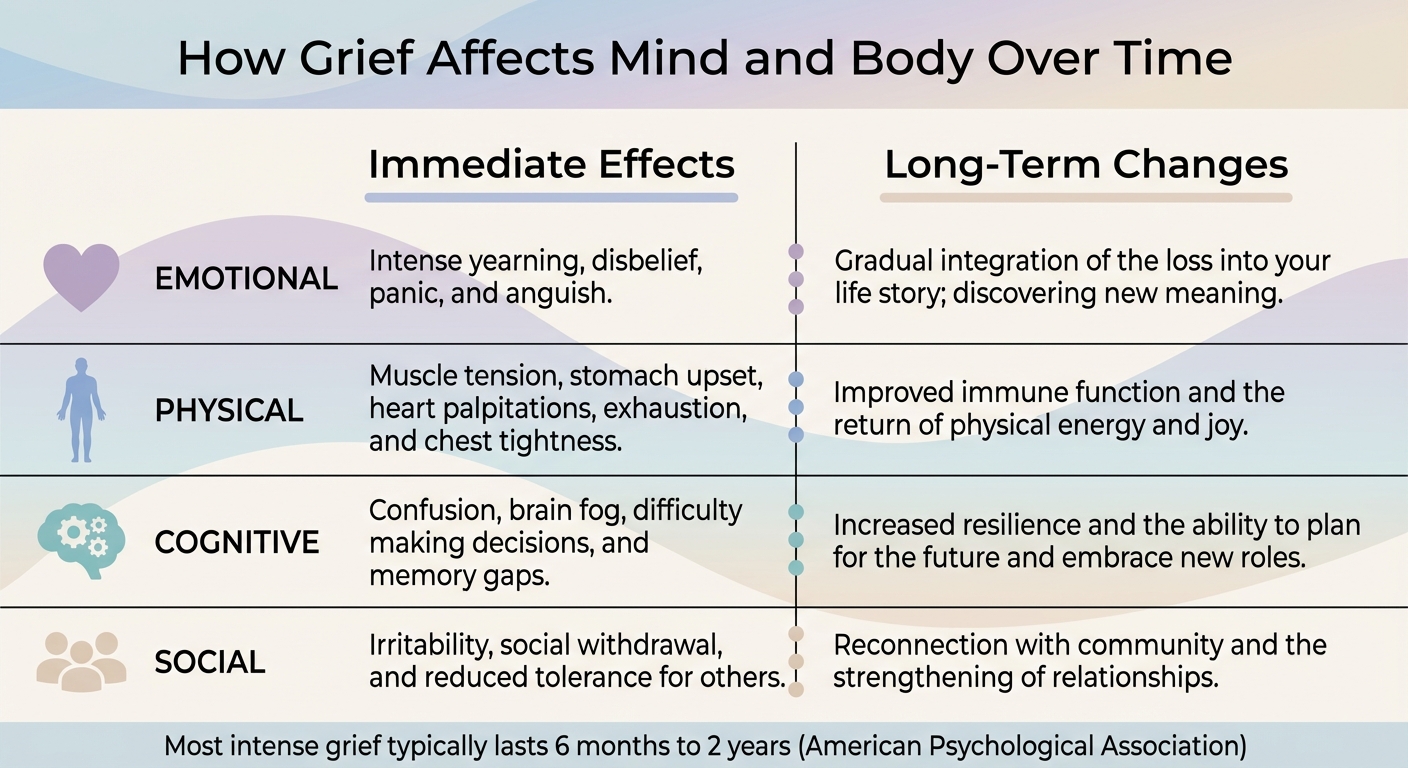
How Grief Affects Mind and Body Over Time
Immediate Effects vs. Long-Term Changes
Grief can hit like a tidal wave, bringing sudden physical and emotional reactions. Physically, you might feel your heart racing, experience stomach discomfort, or notice a tightness in your chest. On the emotional side, intense yearning, disbelief, and a sense of detachment from your surroundings are common.
As time passes, these reactions begin to shift. According to the American Psychological Association, the most intense grief typically lasts between six months and two years. Dr. Itai Danovitch, Chair of the Department of Psychiatry and Behavioral Neurosciences at Cedars-Sinai, describes this process:
"Over time, it gets easier, or less painful, to go back to living – even though the grief may be lifelong."
Here’s a closer look at how grief evolves over time:
| Category | Immediate Effects | Long-Term Changes |
|---|---|---|
| Emotional | Intense yearning, disbelief, panic, and anguish | Gradual integration of the loss into your life story; discovering new meaning |
| Physical | Muscle tension, stomach upset, heart palpitations, exhaustion, and chest tightness | Improved immune function and the return of physical energy and joy |
| Cognitive | Confusion, brain fog, difficulty making decisions, and memory gaps | Increased resilience and the ability to plan for the future and embrace new roles |
| Social | Irritability, social withdrawal, and reduced tolerance for others | Reconnection with community and the strengthening of relationships |
These changes impact your daily life, coloring how you feel, think, and connect with others.
How Grief Shows Up in Daily Life
Grief isn’t confined to moments of reflection – it often seeps into the rhythm of everyday life, affecting your focus, relationships, and physical health.
Daily routines can feel disrupted. Concentrating on tasks, remembering appointments, or staying organized might suddenly feel overwhelming. Many people describe a sense of detachment, as if they’re moving through life on autopilot.
Relationships can also take a hit. You might become more irritable, withdraw from social interactions, or feel misunderstood by those around you. When your loss isn’t fully acknowledged – like the death of a pet, a divorce, or losing a job – it can lead to disenfranchised grief, which often brings feelings of anger or numbness.
Physically, grief takes a toll. It acts as a significant stressor, overloading your nervous system and weakening your immune defenses, leaving you more susceptible to illness. Suppressed emotions can further manifest as insomnia, anxiety, or even chronic pain. Finding ways to express your grief – whether through crying, movement, or other outlets – can help ease some of this physical strain.
For most people, grief’s intensity gradually diminishes over time. However, about 10% of individuals experience Prolonged Grief Disorder, where profound distress continues for over a year in adults (or six months in children). While grief may never fully leave, its waves usually become gentler, allowing space for renewed energy, deeper connections, and moments of joy.
sbb-itb-b542889
Strategies to Navigate Grief Waves
Accepting That Grief Comes and Goes
Grief has a way of hitting us when we least expect it. The first step in navigating these waves is to simply acknowledge what you’re feeling. Saying something like, "This is loneliness", or "This is anger," – whether out loud or quietly to yourself – can help your mind begin to process the emotion instead of resisting it.
Think of grief as being like shifting weather patterns. Storms of emotion may roll in, linger for a while, and eventually drift away. Observing your feelings without judgment can be helpful. For instance, you might check in with yourself throughout the day, rating your "grief level" on a scale of 1–10. Over time, this can reveal patterns in how your emotions ebb and flow.
Being kind to yourself is essential. When grief feels overwhelming, placing a hand on your heart can serve as a gentle reminder that your pain is a natural part of being human. If emotions become too intense, try using the 4-7-8 breathing technique (inhale for 4 seconds, hold your breath for 7 seconds, and exhale for 8 seconds) to help calm your mind.
Even as you heal, grief doesn’t disappear entirely – it shifts and changes. As Mary-Frances O’Connor explains:
"Healthy people oscillate between focusing on loss-related stressors (e.g., the pain of living without the person) and restoration-related stressors (e.g., engaging in new roles and identities due to the loss)".
These internal strategies can create a foundation for exploring creative outlets that help process your emotions.
Using Art and Writing to Process Emotions
Creative expression can be a powerful way to navigate the complexities of grief. Hospice Wellington in Guelph, Ontario, ran a 12-week art therapy program from April 2015 to March 2020, offering activities like stone-carving, woodworking, and oil painting. Researchers Karen Nelson and Jessica Lukawiecki found that 72% of the 29 participants felt a direct connection between the art-making process and expressing their grief. Nearly half of the participants turned to art therapy because traditional talk therapy hadn’t allowed them to fully articulate their feelings.
One participant expressed it perfectly:
"Art therapy is for when you cannot grasp the words to explain outwardly the feelings you have, the art speaks for you".
Another described how the process worked for them:
"It asked you to take your grief and do something with it… it urged you to reshape your grief, making it almost tangible".
You don’t need to be an artist to benefit from creative expression. Consider starting with art journaling, which combines drawings, collages, or painting with written reflections. You could also create a memory box decorated with photos and keepsakes that hold meaning. Using metaphors in your art – like painting a stormy sea to represent emotional turbulence – or writing letters to your loved one can also help you process your grief [17, 16]. The act of creating itself can be healing, and studies suggest that making art may even boost serotonin levels, helping to counter depression tied to loss. Focus on expressing yourself rather than trying to create something "perfect."
While personal expression is powerful, connecting with others can also play an important role in healing.
Finding Support from Others
Grief can feel isolating, but you don’t have to face it alone. When a wave of grief hits, try saying something like, "I’m having a grief wave right now – and I need help with laundry this week", or "I need someone who will listen." Being clear about what kind of support you need can make it easier for others to help [1, 5, 14].
Support groups can also offer a sense of connection and understanding. Organizations like GriefShare provide directories to help you find local groups where you can share your experiences with others who have faced similar losses. According to the American Psychological Association, intense grief typically lasts anywhere from six months to two years. If your grief continues to disrupt your life significantly after six months, it may be worth consulting a professional grief counselor [9, 14].
Dr. Jessy Levin, Co-director of Bereavement Services at Memorial Sloan Kettering Cancer Center, offers this wise reminder:
"Allow the wave to come, but also allow it to go. Your grief will ebb".
There’s no single "right" way to grieve. What matters most is finding the support and strategies that feel right for you.
Healing with Personalized Memorial Art from Zellerhaus Art

How Custom Memorial Paintings Are Created
The process begins with a personal consultation where you share cherished memories and moments of your loved one. Preston Zeller takes the time to understand the essence of your relationship, focusing on the emotions and experiences that defined it.
During this collaboration, you’ll explore examples of grief-inspired art to pinpoint colors, textures, and styles that resonate with your story. From there, Preston designs a customized blueprint that blends your memories with an aesthetic that feels deeply personal. Throughout the process, you’ll receive one or two updates to ensure the artwork reflects your vision. Once complete, the final piece is delivered with full insurance and a signed statement of authenticity.
Preston describes the experience this way:
"Your memories and your strong emotional attachment are all transformed into a singular commemorative piece deeply unique to you".
For those seeking an even more intimate connection, the artwork can incorporate cremation ashes directly into the paint. This unique approach creates a tangible bond between the painting and your loved one, turning your memories into a meaningful visual narrative.
How Memorial Art Helps with Grief
Grief can feel like an unpredictable storm, but a personalized tribute offers a steady anchor during the healing process. Memorial art provides a creative outlet for navigating complex emotions, offering a way to channel grief into something tangible. As funeral director Andre Roupp from Roupp Funeral Home explains:
"Art is more than just an outlet; it’s a bridge between the heart and the mind".
Abstract designs often reflect the non-linear nature of grief. Because they don’t strive for literal representation, they allow you to experience a full range of emotions – whether it’s sadness, anger, confusion, or even fleeting moments of peace. Engaging with the artwork, whether through its creation or simply viewing it, can help release emotions that might otherwise feel trapped.
Memorial art also serves as a lasting tribute, helping you maintain a meaningful connection with your loved one. Instead of focusing on their physical absence, the artwork becomes a way to honor their memory. When overwhelming waves of grief arise, having a dedicated visual tribute can provide a focal point for your emotions, offering solace and grounding.
Zellerhaus Art Service Options
| Service Option | Description | How It Supports Grief |
|---|---|---|
| Custom Memorial Paintings | Abstract paintings created through personal consultations, often incorporating cremation ashes or other meaningful elements | Provides a deeply personal outlet for grief and creates a lasting, tangible connection to your loved one. |
| Limited Edition Prints | High-quality reproductions of Preston’s grief-inspired artwork from his year-long painting project | Offers an accessible way for families to share a collective tribute and connect with the artist’s journey through loss. |
Both options encourage new rituals for remembrance. Whether you choose to display the artwork in a special place or spend time with it during moments of reflection, these pieces become a meaningful part of your grieving process.
Conclusion
What to Remember
Grief doesn’t follow a straight path; it ebbs and flows, giving you moments to process and pause. This natural rhythm – shifting between confronting your loss and engaging in daily life – is a sign that your healing is on track.
When grief hits, putting a name to what you’re feeling – be it loneliness, anger, or confusion – can help you work through it. It’s also normal to feel physical effects like exhaustion or muscle tension, which are your body’s way of signaling that your emotions need attention.
Creative outlets, such as memorial art, can turn these overwhelming feelings into something tangible and meaningful. Whether it’s through painting, journaling, or another form of expression, these activities offer a way to stay connected to your loved one while navigating your grief.
Moving Forward with Your Grief
As you acknowledge and process these waves of grief, remember they reflect the depth of your bond, not a failure to heal. Living with loss isn’t about achieving closure – it’s about finding new ways to honor and remember your loved one.
Simple rituals of remembrance can provide comfort when emotions resurface. Lighting a candle, visiting a special place, or creating personalized memorial art are just a few ways to keep their memory alive. These practices give space to your grief while helping you move forward. Incorporating memorial art into these rituals can serve as a meaningful link between your cherished memories and your ongoing healing journey.
FAQs
Why does grief sometimes resurface unexpectedly?
Grief has a way of catching us off guard, often surfacing during unexpected moments tied to memories of a loved one. It might be sparked by anniversaries like birthdays or holidays, or by something as simple as a song, a familiar scent, or a certain sound that brings back shared experiences. Even seemingly ordinary things, like a photo or a favorite spot, can stir up intense emotions.
Sometimes, it’s the quiet, reflective moments that bring grief rushing back. When your mind wanders to memories of the person you’ve lost, it can feel like a sudden wave crashing over you. While these moments can be overwhelming, they’re a natural part of the healing journey. Understanding what might trigger these emotions can help you prepare for them and find ways to navigate the feelings when they arise.
Why does grief come back unexpectedly, even after some time has passed?
Grief impacts the brain in powerful ways, especially in the early days following a loss. At first, the brain’s pain and reward systems respond as if it’s dealing with physical pain, while the hippocampus and amygdala lock in the loss as a deeply emotional memory. This is why reminders of a loved one can feel so raw and overwhelming.
As time passes, the brain starts to adjust. It learns to balance those intense reactions by alternating between processing the loss and focusing on rebuilding your life. Gradually, the emotional weight of grief becomes less overwhelming, allowing memories to surface without catching you off guard as often. Still, certain triggers may bring emotions rushing back – it’s a natural part of the healing journey.
How can creating memorial art help you cope with unexpected waves of grief?
Memorial art offers a heartfelt way to navigate the complex emotions tied to grief. Through creative activities like painting, drawing, or sculpting, you can give your feelings a physical form, making them easier to process and reflect on. These artistic outlets allow you to express emotions that might feel too overwhelming or difficult to articulate, providing a safe and therapeutic space to release sadness, anger, or even confusion.
Creating art also encourages mindfulness, helping to quiet the mind and interrupt the cycle of overthinking that often comes with loss. Whether it’s crafting a memory box, piecing together a collage, or sketching a simple design, these creations become lasting tributes to your loved one. They serve as tangible reminders of your bond and offer comfort during moments when grief feels all-consuming. Memorial art turns pain into a meaningful expression, guiding you through the healing process with both creativity and purpose.